The back story
From tailgates to Rodeo Drive: shopping in Los Angeles, the back story
From farmers’ tailgates in 1934 to the three blocks of Rodeo Drive: how LA learnt to shop.

Photo Credit
Image courtesy of © DXR · CC BY-SA 4.0 via Wikimedia CommonsLos Angeles shops the way it lives: outdoors, in the sun and usually after parking. Its great shopping places began with farmers selling from their trucks at 3rd and Fairfax, a single boutique on Rodeo Drive in 1961 and a struggling pedestrian mall in Santa Monica that found its second wind. Here is the back story of how the city learnt to shop, from the tailgate to the most famous three blocks in Beverly Hills.
The boutique that started it
Rodeo Drive is as old as Beverly Hills itself. The Rodeo Land and Water Company was formed in 1906, and Rodeo was among the six first streets built the following year, with Canon, Crescent, Carmelita, Elevado and Lomitas; the city was incorporated in 1914. The area’s Spanish name, El Rodeo de las Aguas, recalls a gathering place of waters.
In 1961 Fred Hayman opened Giorgio Beverly Hills at 273 Rodeo Drive, and a quiet street began to change. The Rodeo Drive Committee, which has stewarded the street since 1977, calls him “the Godfather of Rodeo Drive”: his boutique drew Gucci, Tiffany, Van Cleef & Arpels and Vidal Sassoon after it.
Hayman was the driving force behind the Committee from its founding, and the publicity paid off: by 1980 the city estimated that the district brought in as much as a quarter of its sales tax revenue. In 2003 the Committee created the Rodeo Drive Walk of Style, and in 2027 it turns 50. Few streets have been so carefully managed, or so handsomely rewarded for it.
The Committee now counts more than 100 luxury brands along a three-block stretch of palms. Van Cleef & Arpels is still there, now among Hermès, Bottega Veneta, Valentino, Versace, Salvatore Ferragamo and Tom Ford, with Two Rodeo’s lane at the Wilshire Boulevard end. Three blocks, more than 100 brands: the most efficient way in California to spend a fortune on foot.
Tailgates at 3rd and Fairfax
The farmland came first. In 1880 A.F. Gilmore and a partner bought two dairy farms in the Los Angeles area, and he later took control of a 256-acre ranch at what is now 3rd and Fairfax. The cows have long gone; the family name has stayed on the map.
Across town, the story began with a truck. In July 1934 a dozen farmers parked at 3rd and Fairfax and sold produce from the backs of their trucks, on Gilmore family land; the idea came from Fred Beck and Roger Dahlhjelm, who put it to E.B. Gilmore, and he agreed to try it. The Original Farmers Market grew from those tailgates.
Three blocks, more than 100 brands: the most efficient way in California to spend a fortune on foot.
Next door, close to where the Gilmore Drive-In stood from 1948, The Grove opened in 2002, an open-air centre with a trolley and a dancing fountain. This year it marks 25 years of Christmas at The Grove: proof that in a city without much of a winter, Christmas is something you build.
Santa Monica’s second act
In Santa Monica, Third Street reopened to pedestrians only on 8 November 1965 as the Santa Monica Mall. It became the Third Street Promenade in 1989 after a two-year, $10 million renovation, which brought the topiary Dinosaurs of Santa Monica designed by Les Lalanne. Many musicians began as street performers on its three blocks; the dinosaurs, sensibly, have stayed put.

Photo Credit
Image courtesy of © NewtonCourt · CC BY-SA 4.0 via Wikimedia CommonsTown squares by the sea
Up the coast, Malibu Country Mart was founded in 1975 and reimagined in 1985, half a mile west of Malibu Pier. Its park serves as the town square of Malibu, with a lawn and a play area among the boutiques, which is about as close as Malibu comes to a high street.
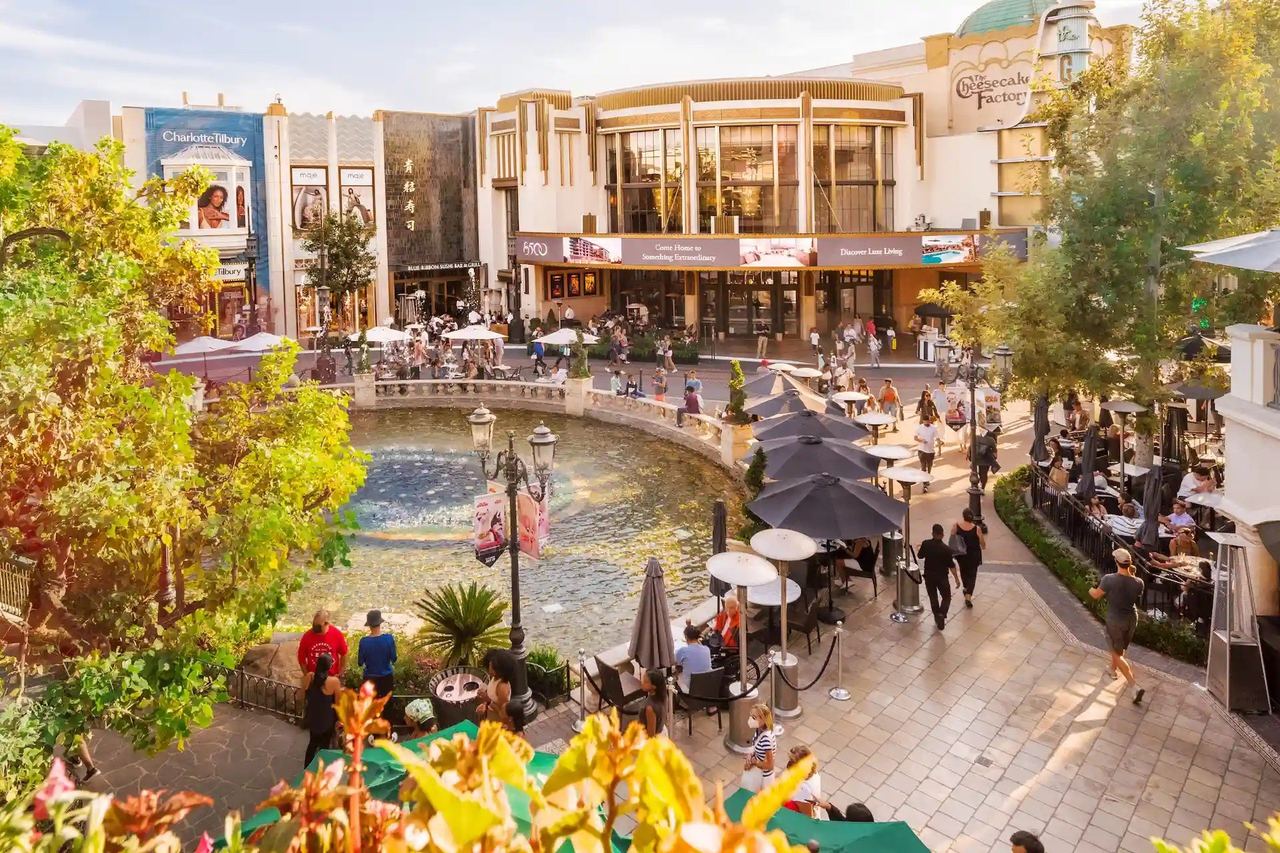
Photo Credit
Image courtesy of © The GroveIn Venice, Abbot Kinney Boulevard carries the name of the man who opened Venice of America in 1905, and its independent shops keep a little of his showmanship. Inland, Glendale’s The Americana at Brand and Culver City’s Platform show the newer, open-air side of the habit, and Westfield Century City the polished one.
Our advice: walk Rodeo Drive on a weekday morning, lunch at the Original Farmers Market, and keep the Promenade and Abbot Kinney Boulevard for late afternoon. Park once and walk: the city’s best shopping is done on foot.

Photo Credit
Image courtesy of © Cayambe · CC BY-SA 4.0 via Wikimedia CommonsWhy it's on our list
- The boutique that started it
- Tailgates at 3rd and Fairfax
- Santa Monica’s second act
- Town squares by the sea
Location
The map comes from Google Maps, which sets its own cookies once it loads.
More in depth
 The back storyBel-Air estates to Malibu beach houses: buying in Los AngelesFrom Bel-Air estates to Malibu beach houses: prime LA property.
 The back storyHollywood, Detroit and the Petersen: Los Angeles and the luxury car, the back storyFrom California’s first freeway to the Petersen’s Vault: how Los Angeles fell for the motor car.
 Coming soonComing soon: the tech the makers have promisedOfficially announced tech, from Gemini glasses to Meta's VR specs, plus the newest arrivals.